The Roy Rogers Show
How a Singing Cowboy Made It to Radio
Roy Rogers came to radio the same way he came to movies — by following Gene Autry's trail and then making his own. He was born Leonard Franklin Slye on November 5, 1911, in Cincinnati, Ohio, and he wouldn't become Roy Rogers on paper until 1942, when he legally adopted the stage name Republic Pictures executives had coined for him in the late 1930s. The studio had built it by pairing the surname of the late humorist Will Rogers with "Roy" — sometimes glossed as a Westernized "Roi," the French word for king. That regal subtext became official the same year he changed his name, when Republic formally bestowed on him the title "King of the Cowboys."
He faced his first microphone in 1931 as part of a group called Uncle Tom Murray's Hollywood Hillbillies. Through the early 1930s he performed with similar outfits — the Texas Outlaws, the Rocky Mountaineers — before joining Bob Nolan and Tim Spencer in late 1933 to form the Pioneer Trio. The group got its lasting name when KFWB broadcaster Harry Hall introduced them on air with the line that they were "too young to be pioneers"; the Sons of the Pioneers they became. By August 8, 1934, they had a contract with the newly founded Decca label and were cutting their first commercial recording. Over the next two years they laid down 32 sides for Decca, among them two Bob Nolan compositions that would follow Rogers for the rest of his career — "Tumbling Tumbleweeds" and "Cool Water." Later lineups of the group included, at various times, Lloyd Perryman, Ken Dawson, and brothers Hugh and Karl Farr, and by 1935 they were appearing in bit parts for Republic Pictures.
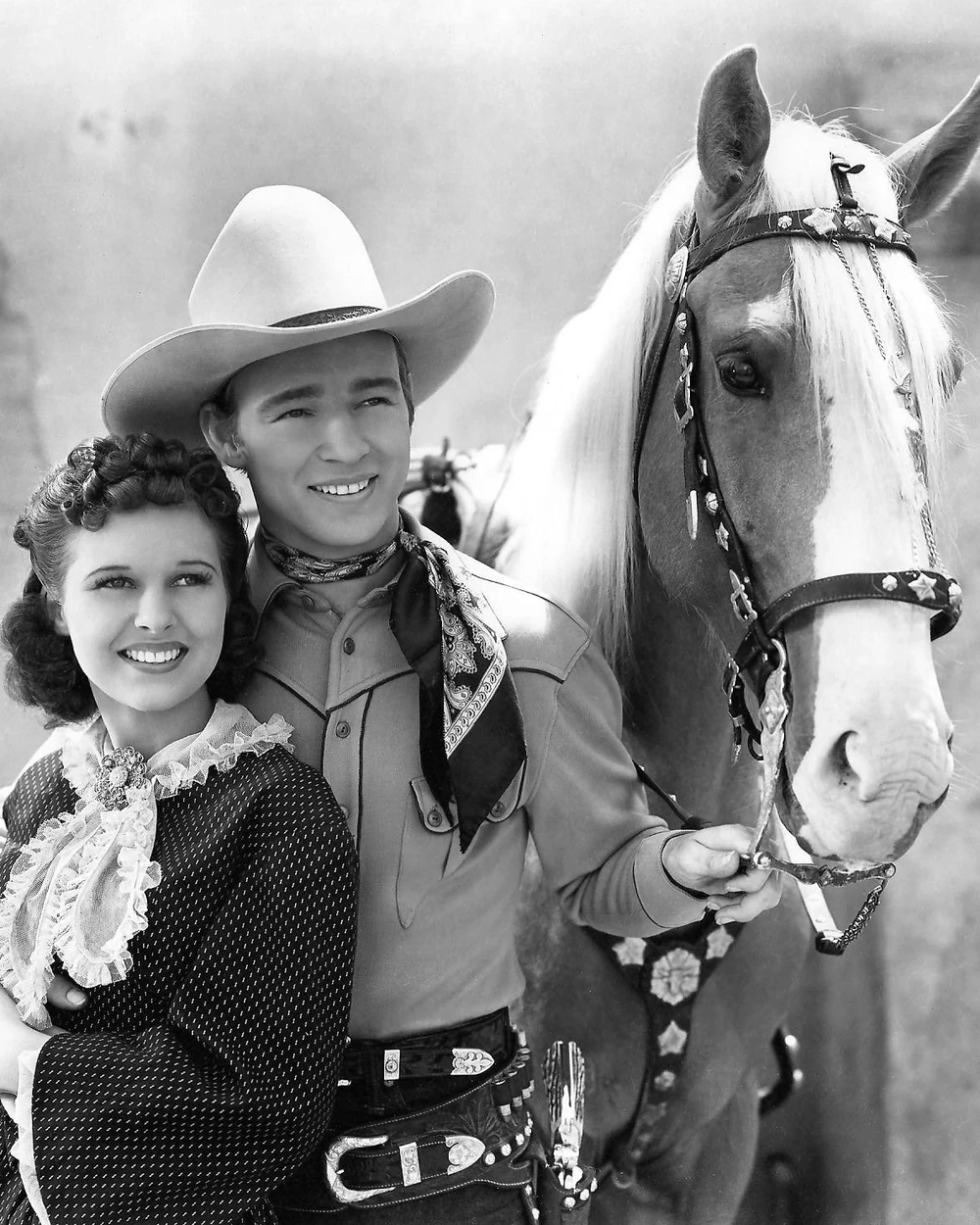
The break came in 1937 when Republic's top cowboy, Gene Autry, quit in a contract dispute. Rogers stepped into the vacancy, bought a palomino colt, named it Trigger, and taught it tricks. By the mid-1940s he was among the top ten money-makers in the entire film industry, with his movies seen by roughly 80 million people per year. His voice was a high-pitched tenor that Radio Life described as "shy, drawling, and courteous" — not an obvious fit for dramatic radio, but it turned out to work just fine for a show built around music, banter, and straightforward Western storytelling.
The Roy Rogers Show premiered on Mutual on November 21, 1944, airing Tuesday nights at 8:30 PM in a 30-minute format. Goodyear Tire and Rubber Company sponsored the run, which lasted through May 15, 1945. That first series had a lighter touch — campfire banter, shorter dramatic sketches, and plenty of singing. The Sons of the Pioneers were on hand performing standards including "Cool Water" and "Tumbling Tumbleweeds," with Perry Botkin leading the Goodyear Orchestra and Verne Smith announcing.
The Cast That Shaped the Show
The most important addition to The Roy Rogers Show was Dale Evans, who joined as costar during the NBC run from October 1946 through March 1947. Evans — born Frances Octavia Smith on October 31, 1912, in Uvalde, Texas — had arrived at her stage name reluctantly, pushed into it by a radio station manager who said it was easier to pronounce. She'd worked as a big-band singer and radio performer, including a stint on the CBS show News and Rhythm, before Republic paired her with Rogers on screen starting with the 1944 film The Cowboy and the Señorita.
The years 1946 to 1948 brought another familiar face into the mix: Gabby Hayes, playing the sidekick-stooge role with the rumpled, grumbling persona that had made him a fixture of Saturday matinee Westerns. Hayes — born George Francis Hayes in 1885 — had come to his Western character by an unlikely route, having spent much of his career in vaudeville and not learning to ride a horse until his 40s. He appeared with Rogers in over 40 films at Republic Pictures between 1939 and 1946. Providing vocal harmony during this period were Foy Willing and the Riders of the Purple Sage, whose members included Johnny Paul, Al Sloey, and Scotty Harrell, with Frank Worth leading the orchestra.
Pat Brady eventually replaced Hayes in the sidekick role. Brady — born Robert Ellsworth Patrick Aloysius Brady on December 31, 1914, in Toledo, Ohio — had actually been recommended for the Sons of the Pioneers by Rogers himself when Rogers left the group in 1937. He served in World War II as a tank crewman in the 4th Armored Division under General Patton's Third Army and reportedly earned a Bronze Star and two Purple Hearts before returning to civilian work. After Brady's first stint in the sidekick role, around 1951 the show introduced a new supporting character: Jonah Wilde, played by Forrest Lewis and billed as "the wisest trail scout of them all." Brady came back to the sidekick role around 1952 and stayed for the long haul, later reprising it on the NBC television series where he drove a 1946 Willys Jeep named Nellybelle.
Sponsors, Networks, and How the Show Kept Moving
The show's network history traces a winding path. After the first Mutual run ended in May 1945, Rogers returned to radio on NBC from October 5, 1946, through March 29, 1947, sponsored by Miles Laboratories, airing Saturday nights at 9 PM. He went back to Mutual from August 1948 through May 1951, this time sponsored by Quaker Oats and airing Sunday evenings at 6 PM. Then it was NBC again from October 5, 1951, through July 21, 1955, with the show moving from Friday nights to Thursdays and eventually attracting Dodge as a sponsor beginning in January 1954. Post Toasties handled sponsorship from 1951 through 1953.
The 1948 return to Mutual was an early example of transcribed — pre-recorded — drama. Rogers's contractual commitments wouldn't allow him to do the show live, so the episodes were recorded in advance. By this point the format had shifted away from the lighter campfire feel of the first Mutual run. Radio Life reviewed the 1948 show as "typical western drammer," in which Rogers and Gabby Hayes met villainous adversity, saved Evans's ranch-home or her father or her younger brother, then rode off. The Christian Science Monitor captured the formula with equal economy: "a little song, a little riding, a little shooting, and a girl to be saved from hazard." It wasn't high drama, but it delivered what the audience showed up for.
Around 1952, scripts were handled by Ray Wilson, music by Milton Charles, songs by the Whippoorwills, and direction by Tom Hargis or Fran Van Hartesveldt. The following year, Ralph Rose took over as writer-director.
The Sound of the Show
The musical backbone of The Roy Rogers Show is inseparable from its identity. The opening theme was often "It's Roundup Time on the Double-R-Bar," a reference to Rogers's ranch in the show's fictional Paradise Valley. Before "Happy Trails" settled into place as the closing number, the song "Smiles Are Made Of Sunshine" served as the sign-off. By 1953, "Happy Trails" had become the show's all-around theme — and it turned out to be something more than a radio sign-off.
Dale Evans wrote "Happy Trails" after being inspired by a trombone slide in Ferde Grofé's Grand Canyon Suite that sounded to her like someone saying "happy trails" echoing in a canyon. The song was released commercially in 1952 as a 78 RPM and 45 RPM record by Rogers and Evans with the Whippoorwills and Orchestra on RCA Victor Records. Decades later, the 1952 recording was inducted into the Library of Congress National Recording Registry as "culturally, historically, and/or aesthetically significant." Members of the Western Writers of America also chose it as one of the Top 100 Western songs of all time.
Rogers closed each episode with a line that became a signature: "Goodbye, good luck, and may the good Lord take a likin' to ya." It reflected his Christian ideals and his belief in the Golden Rule, and it was the kind of sign-off that listeners remembered long after the episode's plot had faded.
The Final Season and the Shift Toward Adults
In 1953, sponsor Dodge pushed for a reorganization of the show aimed at a more adult audience. Writer-director Ralph Rose developed a mystery format for the final season, a shift away from the straightforward Western adventure that had defined most of the run. Dale Evans's songs were woven into the plots rather than performed as standalone numbers, and Rogers was asked to take on new musical challenges — including performing "Old Man River." It was a different kind of show from the campfire banter of 1944, but the core ensemble remained: Roy Rogers, Dale Evans, their horses Trigger and Buttermilk, dog Bullet, and sidekick Pat Brady.
The show carried on until July 21, 1955, running on more than 500 stations during its broadcast life. By that point the television version — which had launched in 1951 — was the more visible part of the Rogers enterprise, finishing in the Nielsen top 30 in its early seasons and earning an Emmy nomination in 1955 for Best Western or Adventure Series. The radio series wound down quietly as the industry shifted.
Rogers himself went on to a remarkable post-radio career: four stars on the Hollywood Walk of Fame (for motion pictures, television, radio, and as a founding member of the Sons of the Pioneers, all awarded on February 8, 1960) and two inductions into the Country Music Hall of Fame — first in 1980 with the Sons of the Pioneers, and again in 1988 for his individual career. The merchandising empire behind all this was built on a quietly remarkable piece of business: a 1940 contract clause with Republic Pictures that gave Rogers the rights to his own name, voice, and likeness, making him second only to Walt Disney in the number of items bearing his name. At his peak there were roughly 400 such items in circulation; his picture eventually rode on something like 2.5 billion Post Cereals boxes during the television run, and over 200 fan clubs were active around the world — the London chapter alone claimed more than 50,000 members, reportedly the largest fan club for any performer on earth at the time. In 1968 Rogers licensed his name to the Marriott Corporation, which converted its Hot Shoppes chain into Roy Rogers Restaurants, a franchise that grew to more than 600 locations at its peak. His manager estimated that between 1945 and 1975 the public spent more than a billion dollars on the Roy Rogers name.
He died on July 6, 1998, in Apple Valley, California. Dale Evans, who outlived him by nearly three years, died on February 7, 2001, in the same city. The radio show they made together was just one chapter, but it was the one that put the closing words in millions of living rooms every week.